Drawing inspiration from the race run by HM Queen Elizabeth II

“Therefore, since we are surrounded by so great a cloud of witnesses, let us also lay aside every weight, and sin which clings so closely, and let us run with endurance the race that is set before us, looking to Jesus, the founder and perfecter of our faith, who for the joy that was set before him endured the cross, despising the shame, and is seated at the right hand of the throne of God.”

(Hebrews 12:1-3, ESV)

The death of Queen Elizabeth has left the nation in a collective combination of grief and thankfulness. 

I judge that the majority of the nation admired her for her steadfast dedication to duty, her moral inspiration and her leadership – technically having power to govern yet not seeking to interfere in the proper working of a parliamentary democracy beyond offering wise counsel to Prime Ministers.

Those of us with faith in Christ also point to her public declarations of faith, which have been widely circulated in recent days. Quotes such as those from her final Christmas message last year:

“Jesus whose teachings have been handed down from generation to generation and have been the bedrock of my faith. His birth marked a new beginning. As the carol says, “The hopes and fears of all the years are met in thee tonight”

We are not called to be the leader of a nation. Yet we are all called to play a part in God’s plan for this world.

As the passage from Hebrews encourages us, we are to run the race with endurance, seeking to be as lean and focused on Jesus as possible.

Our Queen was not a ‘runner’, yet she understood the concept of endurance for the race that was set before her. And she ran it well.

So how can we, as runners with athletic inclinations or just ordinary people follow Queen Elizabeth’s example of running the spiritual race with endurance?

1) Understand that there are good and bad circumstances for us to press through. Be thankful for what you have.

Sometimes life is tough. The Queen lived through enormous societal change and increasing pressure on the Monarchy.  We should not be blinded by her wealth and fame. She endured personal and family difficulties like any of us do. And sometimes the burdens of wealth and fame can add to the difficulties of circumstances.

Sometimes life is tough. As runners, we often struggle to find the time for training. Sometimes we’re injured and we have to modify our activities to allow our bodies to heal.

I often feel invincible when not injured. And when I am injured I’m tempted to think that I’ll never be able to run fast again. Neither is true.

But if I cultivate a mentality that focuses on being thankful to God for what I have and what I can do (even if that’s not running!), that builds both my mental resilience and my faith.

2) Plan for the long term but live to do the best you can today.

Elizabeth set out to serve the nation for the whole of her life, whether that was long or short.

When you run a marathon, you wear lightweight kit and set off at a pace that will allow you to complete the race. You don’t burn all your energy at once.

The passage from Hebrews tells us to “also lay aside every weight, and sin which clings so closely”.

So don’t live solely for today by seeking easy solutions in earthy pleasure right now.  (…unless that pleasure is going out for the run that you need to do… 😊)

Accept your weaknesses and live a life that is continually being transformed by the grace of God.

Be thankful and enjoy what God puts before you to enjoy each day.  But don’t be overloaded by burdens that God has not called us to carry (“Do not worry about tomorrow…”) or the guilt and consequences of our own sin.

If you have an issue with sin, repent and keep a short account with God. Find people to be alongside you to help you to break bad habits of thought and deed.

If you have a struggle, then endure with patience and seek the answer in God, trusting Him to bring you through in the long term.

3) Keep yourself centred on the goal, being realistic about where you are now.

I find that unless I have some goal race in the upcoming year, I don’t find the motivation to train effectively, being patient as I build towards race fitness.

Right now, I’m in training for the World Age Group Triathlon Championships, which are being held in Abu Dhabi in November.

Because there are 11 weeks to go, I know what sort of training I need to do. I’m currently building all-round endurance, basic core strength and flexibility. I’m trying in particular to build my running endurance since running has been the weakest part of my Triathlon performance in recent races. Speed is not required right now.

Last night I ran a one-mile time trial with my Athletics club.  The time was over a minute off my PB. But that was set 8 years ago (younger me!) and before I had a bad accident which has meant a long road to recovery for the past three years.  And I also have a lot of training volume in my legs right now.

So I’m satisfied since based upon my current level of fitness, it was spot on with what my (Stryd app) race predictor says I should be capable of.

And at the end of the year at the championships, even when I’ve built more speed, I’m going to be realistic about my medal chances (zero!) and will be satisfied to finish in the middle of the results rankings. It’s the best that I should expect, based on the genetic gifts that God has given me. I can’t get hung up on how others perform if I’ve done the best I can do.

It’s good enough that I’m good enough to get selected for the GB Age Group team, and I’ll do my best to honour the flag on my tri suit.

Every day I get up and have a training plan to execute.  However, that’s both physical and spiritual…

“for while bodily training is of some value, godliness is of value in every way, as it holds promise for the present life and also for the life to come.” (1 Tim 4:8 – ESV)

At the end, my goal is to look to Jesus as I run the earthly race he has called me to. Enjoying what I can here on earth (“bodily training is of some value…”) but acknowledging my ultimate destiny is with Him in heaven.
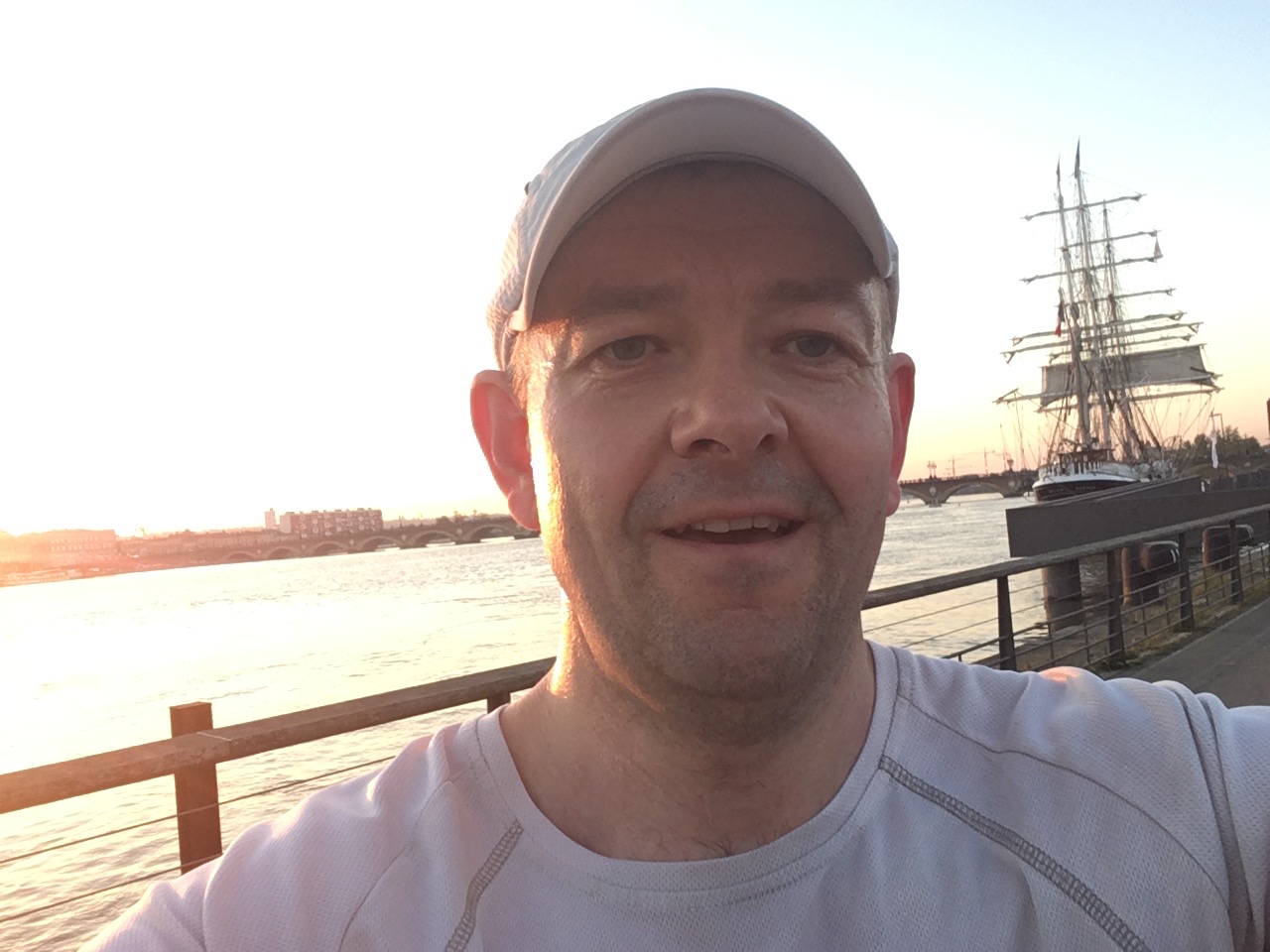
It’s good enough that I’m loved and called by God and I’ll do my best to honour Him.

Gratitude – a key to satisfaction?

It’s Sunday morning and I’ve just come back from a slow 5km jog along the peaceful banks of the river near my home.  Dog walkers were meandering along. Swans were gliding majestically along the mirror-like surface of the wide sections of the waterway.  The sun was out and all was well.

It was the second consecutive day I’ve run – the first time that has happened since before my accident last summer.  Yesterday’s run was more frantic – a different 5k route but run in race conditions.  Normally on Saturday that would have been normal – with parkrun a fixture on my weekly calendar for several years.

But this weekend is different. I’m aware of a profound sense of gratitude that I can get out and enjoy the air, enjoy my running and enjoy feeling… alive.

It’s a little while since I’ve blogged here, but the world has changed again.  My mother-in-law passed away just before Christmas, and then, more recently, we’ve had the COVID-19 lockdown.  My wife and I were both sick near the beginning of the lockdown  (probably COVID-19) and that ruled out any kind of activity for around three weeks.

I’m thankful for…

  • Today’s consecutive running streak, which left me with a profound sense of gratitude and as a result, a sense of peace.
  • I’m thankful that I can run at all.  As I stepped out of my front door this morning I remembered that my accident last August could easily have left me paralysed or worse.
  • I’m thankful that I’ve recovered some level of fitness, so that slow running is now a pleasure rather than a struggle.
  • I’m thankful that I live in a location where I have access to such wonderful running routes – I can choose a flat or hilly route depending upon how I feel.
  • I’m thankful that, although my mother-in-law is no longer with us and we are still grieving, she is in a better place and, as a high-risk person with medical issues, she did not have to face COVID-19 or social isolation stress.  My thoughts are still with those who’ve suffered a loss at this time or who are struggling with being on their own.
  • Finally, I’m much more thankful for the basic things in life.  We have food on the table and a roof over our head.  I don’t have very much income at present but I have time together with my wife and bizarrely, the imperative to connect with relatives over videoconference means that we’re talking with our dispersed family more during the lockdown.

So, lockdown or not, I’m reminded that gratitude is a fundamental part of satisfaction –   being thankful for what I have and what I can do, not anxious about what I don’t have or can’t do.

What can you be thankful for?

The spiritual parallels

As a Christian, I’m conscious that the principle of gratitude goes much deeper. 

My first awareness of Christian gratitude goes back to the primary school prayer said before school dinner – “For what we are about the receive may the Lord make us truly grateful…Amen”

However, after coming into a commitment to Christ in my teens, I’ve learned that there are numerous Biblical instructions to be thankful.  It may be that the above prayer has taken 40 years to be fulfilled!

I now realise that it’s not just a good suggestion – it’s a principle we are urged to grab hold of, as a key part to living the way God intended us to.

We are encouraged to come to worship God with thanksgiving (Psalm 100).  In writing to the Thessalonians the Apostle Paul told us to  “give thanks in all circumstances; for this is God’s will for you in Christ Jesus.”  This was, alongside “Rejoice always, pray continually”, his daily philosophy.  

Separately, writing to the Philippians, he noted:

“I am not saying this because I am in need, for I have learned to be content whatever the circumstances. I know what it is to be in need, and I know what it is to have plenty. I have learned the secret of being content in any and every situation, whether well fed or hungry, whether living in plenty or in want.  I can do all this through him who gives me strength.”

So, if we want to be truly satisfied, it’s not a case of having stuff.  It’s not even a case of conjuring up a ‘positive mental attitude’. 

It’s about lifestyle habits of thinking that weave gratitude with the inner joy of knowing Christ, reflected back to him in worship and prayer.

And so I will continue to be thankful for all I am and have.

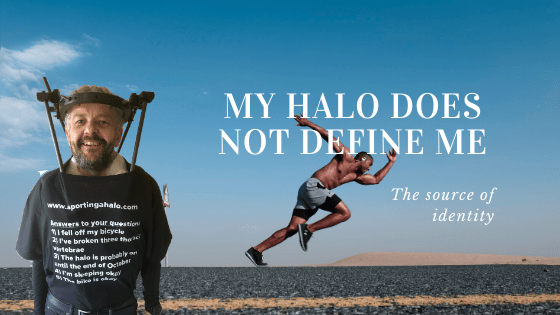
My Halo does not define me

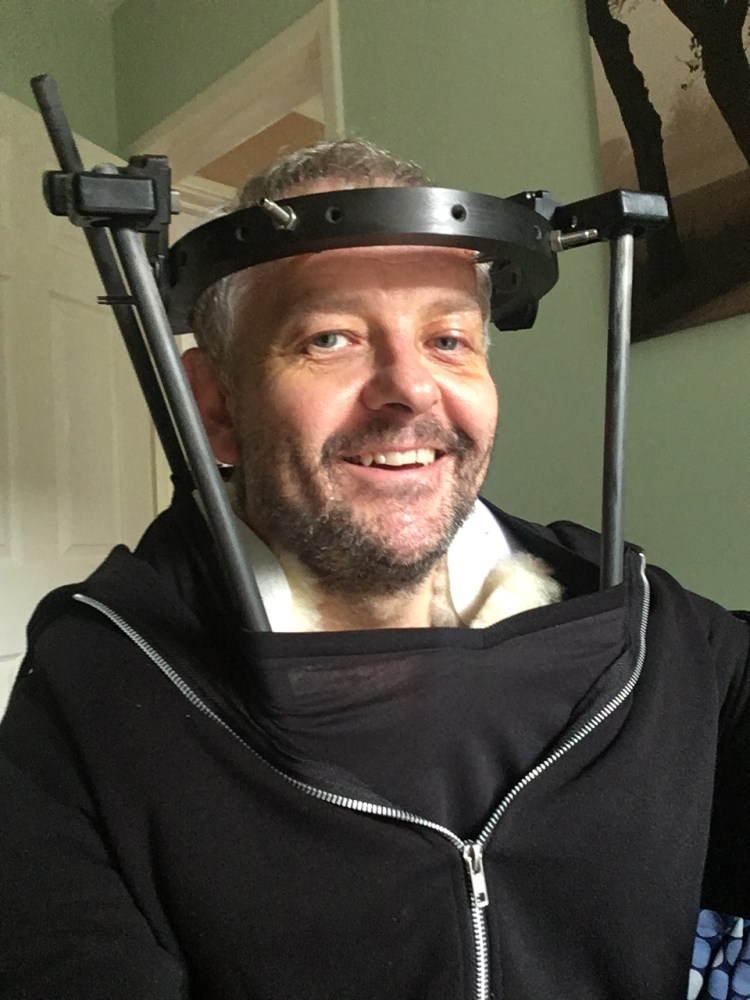
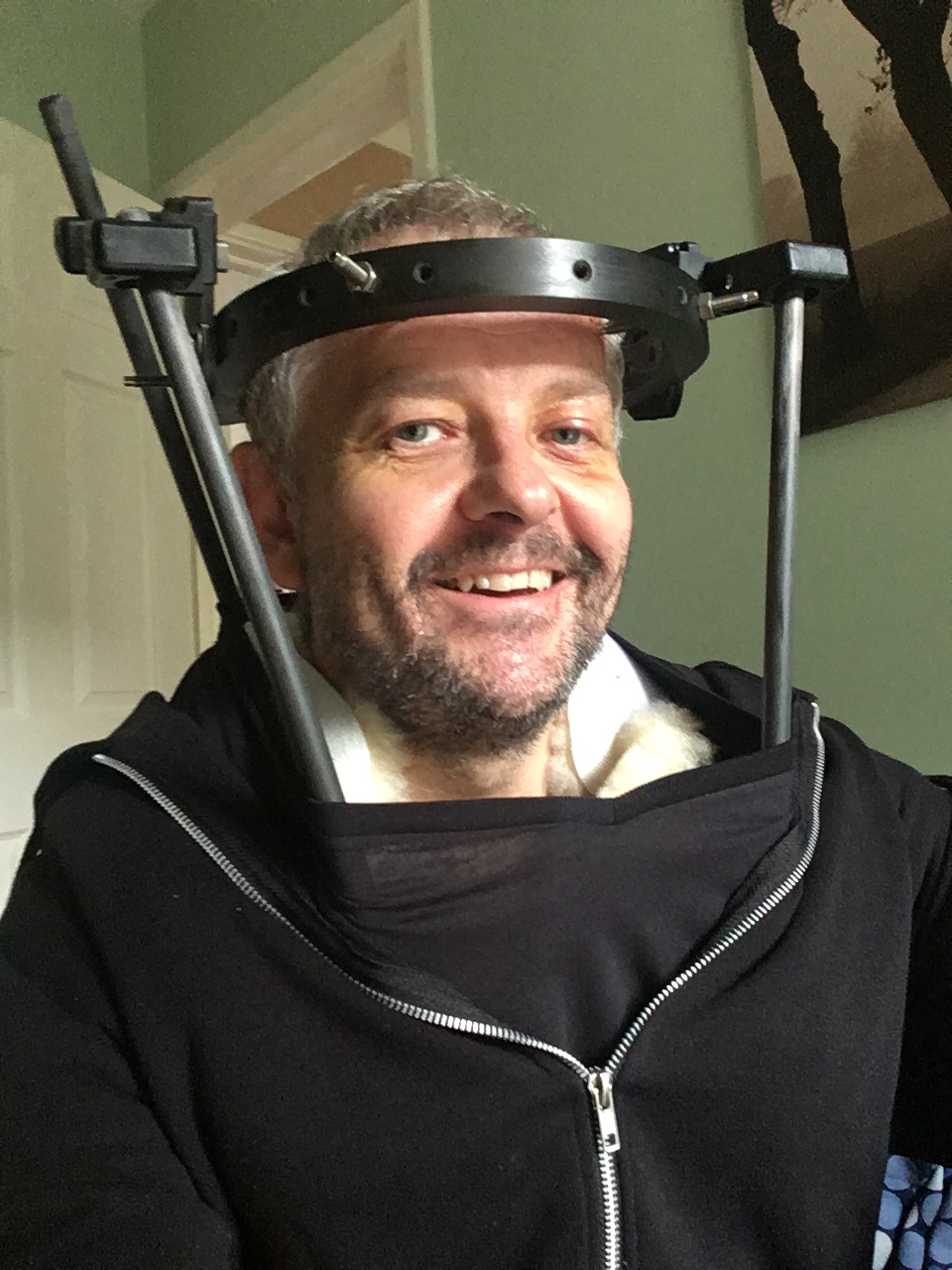
Hurrah!  Finally, the day has come and my halo has been removed.  I’ll no doubt talk about what that feels like in a later blog, but it’s been a really interesting experience to look and feel different in the 12 weeks since my accident.

And particularly, it’s taught me something about identity – how I define myself. The sudden changes from athlete to halo-man to ‘normal’ again have brought into sharp relief how people see me and how I see myself.

Before the accident, I was aware that I shouldn’t define myself by my status as an athlete – because I am much more than what I do.

Nevertheless, it’s good to acknowledge our achievements and turn that into positive mental feedback.  As athletes, this builds confidence to perform, as we recycle positive visualisation into training sessions and competition. 

So how do we define our identity when we pursue sporting excellence?

My age-group triathlon journey

There have been many moments when I’ve been out training and by telling myself that I’m a GB Age group Multisport athlete have found reserves of endurance and speed.  However, I’ve wrestled with balancing up my pride at having raced for my country (albeit at sub-elite age-group level), with not wanting to seem a show-off.  After all – I’m hardly an Olympic athlete. 

I sort of reconciled this a while ago, chatting to Mac Heslop – one of my long-term mentors at my athletics club.  He was one of the first guys to welcome me into the endurance training group at Durham City Harriers when I started running seriously 15 years ago. Sadly, Mac passed away suddenly last year aged 72, but his words have endured in my head.

A couple of years back, I wore my GB age group training kit to a session and mentioned to Mac that I felt a little awkward.  Without hesitation, he replied “You’ve earned it – so wear it.”  A coach at the club also noted that having my GB tracksuit visible encouraged junior athletes.

And so, I’ve tried not to boast, but if I can encourage others to raise their expectations, then I’ve been happy enough not to hide my achievements.  Occasionally, while being overtaken while out training or racing, I think “I wonder if that person knows they’ve just overtaken an international athlete?”.  This gives me a reality check in my head – to remind myself that my identity should not be as a high-performing athlete!

Athletes who have to stop being athletes

There have been many stories of elite athletes who have struggled mentally after retiring.  Many years of dedicated training are required to get to that level. Performance requires an exceptional level of self-belief. 

It’s no surprise that many elite athletes end up with their identity bound up in their status or performance as an athlete.  When this is all taken away through injury or the inevitable deterioration effects of ageing, it’s a challenge for them to establish their identity in other ways.

This is a warning to us all – don’t invest your entire identity on what you do, because someday it could all end.

How should I define myself?

When I ran marathons, I was a marathon runner.

When I added swimming and running, I became a triathlete.

And when I qualified for the GB Age-group team, I became something more – or did I?

None of this was who I really was.

And when in August 2019 I fell off my bike, broke my back and was fitted with a Halo brace, I suddenly ceased to be an athlete.  I was a man in a halo.

It was very interesting to see how people reacted to me.  I suddenly because much more visible – an oddity to some.  One of my son’s friends at his graduation: “Have you seen that man over there with the weird cage on his head?” My Son: “Yup – that’s my dad…”.  However, I’ve learned that when people look at me strangely, if I make eye contact with them and smile, more often than not it disarms their embarrassment and I’ve therefore had more conversations with complete strangers in the last three months than I can recall in the past several years.

To so many people who knew me before the accident – I have become someone to express love and encouragement to.  I’ve been so blessed and encouraged by the outpouring of support I’ve had both in-person and on social media.

Therefore, I have become the centre of attention.  It’s been easy to feed my ego as virtually everyone I meet wants to know what happened and how my recovery is going. So many people were asking that I had a t-shirt printed (see blog header).

But what now?  My halo has gone.  No-one looks at me strangely anymore (I hope!).  People are going to work out that I am much better and stop asking how I am all the time.

What is my identity now?  No Halo.  I can’t yet run, swim or cycle.  I can’t define myself as an athlete.

If throughout the process above, I had defined myself by what I did, then I think that right now I would have a problem – my ego is not now being fuelled by all the attention I am getting.  I’d love to say I’m perfect, but that’s not true. It has been a challenge not to find myself unhelpfully puffed up with all the attention.

So how do I define my identity?

The sudden changes from athlete to halo-man to ‘normal’ again have exposed some unhelpful ego/motivation.  I’ve had to think a lot therefore about how I define myself.

Happily, I’ve spent the past thirty years establishing an understanding that’s not based upon what I do.  Accepting who I am I terms of character and potential as a human being transcends what activities I do and how I perform.  That’s not to say that from time to time there’s isn’t an element of pride that creeps in an imprints some element of identity from those activities I pursue.

But at the root of it all, I am not a runner, a Triathlete, or a strange-looking man in a halo.

I am Andy.  I am unique and flawed but on a journey to becoming a better person.  And I can accept that, regardless of circumstance.  

The spiritual bit

I am a Christian.  I can’t separate the concept of my identity with what I believe, through faith in Jesus Christ.

I’m not saying that you need to be a Christian to have a strong sense of identity that’s separated from what you do.  But for me, my faith is fundamental to not only my world-view but also my sense of self.

Therefore, if anyone is in Christ, the new creation has come:] The old has gone, the new is here!

2 Corinthians 5:17 New International Version (NIV)

Many people interpret religion as being a set of rules that defines what you have to do. And by extension, identity can be rooted in what you have done (for good or ill)  But the Christian faith is not a set of rules.  It is an acknowledgement of what God has done for us, by sending his Son to this world to die for us – to take the punishment for our sin and rebellion against God.

And so my identity is not based upon what I have done.  Because if it were, my status as a sinner would prevail and I would still be subject to God’s judgement.  However, God has given me a new life and a new identity. 

I am adopted into God’s family – I am a child of God. And that is what defines me.

What I then choose to do, in the freedom I have, is still important.  I can choose to enjoy the physical abilities that God has blessed me with by participating in sport.  I can enjoy food, drink, companionship and seeing the physical world around me.  Even work can be enjoyed.  But none of that defines who I really am.

I am Andy – secure in being loved and adopted by God.  What I do or look like is secondary.

Why community is still important to this introverted athlete

I want it out in the open.  It’s who I am and I’m not ashamed.

I am an introvert.

You might think that’s why I picked sports that involve a degree of solitude.  For most of my life I have been a runner.  All those hours of solitude – just me and my thoughts as I pound out the miles.

And to some extent it is true that spending time without having to work to interact with other people does match my personality.  But only because of what being an introvert really means.

In psychology, some models hypothesise that the observed behaviour of introverts or extraverts refers to the level of cortical arousal that individuals experience in the company of others.  Introverts experience a higher level, and therefore find social interaction more tiring/demanding and need to withdraw to recharge.  On the other hand extraverts experience lower levels and therefore seek out company and social engagement to be stimulated.

This makes a lot of sense to me.  I’m relatively comfortable and animated in a social setting, but I simply find it tiring to be with other people, even though I love their company, I’m quite happy to be alone, or to ‘simply be’ with my wife or very close family.  They don’t count as “other people”

For many years I trained and ran on my own, occasionally entering half marathon races but not really making any progress. So a few years back I decided that I would join a running club to see what I could learn.

For sure, I learned a lot about training methods. But I also met a whole group of people who I now call my friends.  I actually enjoy running with them much more than I enjoy running on my own – even though most of my running is still solo.

When I later took up Triathlon  I discovered a further group of friends, who supported my development as a multisport athlete but moreover were just nice people to be around. 

Subsequently, by qualifying for the GB age-group Duathlon team, I’ve travelled to multiple European and World Championships and competed in dozens of qualifying races in the UK.  And so I’ve bonded with another whole group of people, with whom I’ve shared coffee, beer, meals and occasionally the work on a bike in a draft-legal race.

We may be very different personalities, but what unites us is a love for our chosen sport. 

And in all the other areas of life where I’ve been alongside people with common interests. I have a much wider group of friends. Whether it is because I belong to a church, went to school/college with someone, or they are a current or former colleagues. 

We are united through common values or interests

I still value my time alone, but I’ve also valued these groups of friends who have become my ‘tribe’, my community, because of what we share together.  But maybe to some extent I’ve taken that for granted.

What my Halo has taught me about community

I realise I underestimated just how much my community of fellow human beings meant to me. In the past month:

  • On the night of my accident, my Triathlon club companions were incredibly supportive.
  • In the subsequent week my running buddies had a whip-round, bought me books to stop me getting bored and recorded a ‘get well soon’ video for Facebook.
  • During my time in hospital, so many people came to see me while I was flat out with black eyes and in pain. More have visited since I got home. 
  • I know many of my business contacts were similarly concerned about my injuries and wishing me a speedy recovery but just had to pass the message on via others.
  • And being a Facebook user (*addict), it was fascinating and wonderful to see all the strands of my community weaving together in liking comments and offering literally hundreds of heartfelt thoughts and prayers.

In summary, knowing I was loved and supported and there were people rooting for my recovery helped me keep positive.  

If you’re one of those people, I’d just like you to know how epic you are!  Thanks for your prayers, love and support.  I know more than ever that I value the community of people in my life.

Moreover, I believe in a God who heals and in many ways my recovery has been miraculous.  It was a miracle that I was not more badly hurt in the accident.  It was a miracle that I managed to get out of the hospital within 8 days to be able to attend my Son’s wedding.  And my recovery since then has been miraculous in that whilst I still have this darned halo on, I’m mobile, back working and in very little discomfort.

I am incredibly grateful for the prayers of people of faith.

The Spiritual Parallel

Okay – so I normally tag the spiritual bit at the bottom of my blog, but today I’ve snuck some of it in above, just purely because my faith is so fundamentally bound up with the church community I’m part of, that I simply couldn’t leave that part out.

But there is still a bigger picture here.

I was made as a unique individual. Having introverted tendencies is fully part of how I was made, and that’s okay.  I’m okay with being alone – I don’t tend to get lonely.  But what’s not okay is for me to think that I can use that as an excuse to withdraw. 

If I choose to withdraw, not only will I miss out on the valuable input of others to my life, but others will miss out on what I am able to do to contribute positively to their lives.

God made people with all kinds of personalities.but he still made humans to live in relationship with others, in community.  Right from the outset of the Bible, He acknowledged that it was not good for Adam to be alone, so he instituted a relationship with his wife.  And throughout history, He guided mankind to cooperate, as he chose a people for himself. 

In the New Testament, following the death and resurrection of Jesus, we see that community principle working out through the existence of the Church, alongside the principle that God still wants the whole of mankind, including the historic nation of Israel, to come to faith and be part of His community.

That is why the church is described as the body of Christ – there are many different personalities, skills and preferences amongst people of faith, but by having a commonality of faith we are all part of the same community and only fulfil our true humanity when expressing ourselves as part of the whole.

25 so that there should be no division in the body, but that its parts should have equal concern for each other. 26 If one part suffers, every part suffers with it; if one part is honored, every part rejoices with it. 27 Now you are the body of Christ, and each one of you is a part of it.

1 Corinthians 12:25-27 New International Version (NIV)

There are people who claim to be Christians who are not part of any church, for any number of reasons, including past hurts because imperfect people in their community have let them down.  I can’t judge their motivation, but I can see that they must be missing out on blessings for themselves, and others will be missing out on what those individuals can contribute.

So I pray that it doesn’t take a major crisis like my accident, to make you truly appreciate that you are much better off being fully committed to Christ and integrated in his body, the Church.  If you are outside of Christ, on the fringe of things or even trying to walk a life of faith without believers around you, however imperfect, you are not living life to the full and others will be missing the best of you.

I have close church friends who I can pour my heart out to confidentially, I have a wider group of church friends who I have the privilege to be able to love and encourage on a one-to-one basis. I have a wider congregation who I can inspire to worship through using my musical gifts and who I can encourage to have faith by sharing my testimony. And beyond that, I’ve got a rich network of relationships with fantastic people who are not at this point Christians, but for whom I am profoundly grateful to God and who I want to be a blessing to.

What about you?  Do you fully appreciate the community around you?  Have you truly found fulfilment as part of community?

Header photo by Igor Kasalovic on Unsplash

The importance of a strong core and all-round strength

I don’t know about you, but since my online activity frequently involves sporting activity, the targeted online adverts that I get shown often involve titles such as “Develop a strong core in 30 days”, “Get a six-pack in six weeks”, “Get ripped with this bodyweight workout plan” and so on.

Okay, it would be kind of nice to know that my body is in shape, but most of these ads seem to be appealing to a narcissistic, body-image focused person.  And surely that’s not me?  

My sporting focus is on how fast and far I can run, cycle or swim, not in looking like a Greek god when I take my shirt off.  Which I hasten to add is not entirely appropriate behaviour on most occasions…. (the photo above is not me!)

And so I might have thought a few years back when all I did was run.  My training focus then was all about building leg endurance, honing my running form and developing cardiovascular capability. I considered any upper body muscle as just extra weight to be carried.

But then I started to be coached by people who knew their stuff  and I took up cycling and swimming more seriously.  I realised that having strength in my abdomen and lower back was an essential part of connecting and stabilising my motion, so I could go faster and further.

But it wasn’t until a crisis that I understood how much reliance I had on my core strength.

As I built up my training mileage in 2009 to try to beat three-hours for the marathon, all my training was going well, but I noticed a strange bulge around my belly button. I was still running well, but I thought I’d better get it checked out by my doctor.  He diagnosed a para-umbilical hernia.  Not a serious issue, but one requiring surgery to correct.  

And so, that after a string of personal best performances that summer, I checked into the hospital for a minor procedure to sew up the hernia, a small hole in my muscle wall.  The operation went well but because my middle had just been cut and resewn (very neatly I must say!), I was unable to bend my midriff without extreme pain.  I couldn’t sit up, I couldn’t roll, I couldn’t even hold weight in my hands without discomfort because I had to brace through my tummy.

Without the ability to brace through my core I was rendered completely helpless – at least for the time until the surgical wound had healed.

Since then I’ve at least been much more conscious of putting exercises into my weekly routine to keep my core toned – planks, push-ups, squats, lunges, leg raises etc and general hip and glute flexibility routines.  I haven’t got a six-pack, but I don’t need any of those adverts which promise miracle workout routines.

And so, onto my recent accident and injuries.

Now that my upper spine, neck and shoulders are immobilised and I have a heavy halo vest on my upper body (see above), I’m very grateful for my core routine.  I now have to move the entire weight of my head and torso from my lower back and abdominal muscles.  And even then, it has been a struggle to build up the necessary strength to move around comfortably.

So whilst I’m losing a chunk of overall fitness while I’m wearing the halo since I can’t run cycle or swim, I think I’m getting ripped in my abs! 

This is not quite the fitness plan that all those internet adverts promised…!

My learning from this time of trial: Building a strong core helps in every circumstance – whether I’m flying in the form of my life or whether I’m injured.

So a question for you…

How’s your physical core strength?

The spiritual parallels…

Whatever the visible signs of religious behaviour, all of it is meaningless without a strong core to connect it all up.

Many people erroneously interpret religion as a set of rules that must be obeyed to gain favour with God.  But the Christian faith is different. 

When Jesus came to earth and started teaching, he encountered the Jewish nation bound up in religion and over-zealous focus on rules, dominated by sects such as the Pharisees and Sadducees.  People questioning this and truly seeking the reality of God had all kinds of questions of Jesus.

The Pharisees, whose mindset was that obedience to rules gave brought them closer to God, came to Jesus to test him:

36 “Teacher, which is the greatest commandment in the Law?”

Matthew 22:36-39 New International Version (NIV)

And Jesus answered with one of the most profound statements of the whole Bible – that, at the core of all the principles, laws and regulations are two very simple principles, that connect everything together:

37 Jesus replied: “‘Love the Lord your God with all your heart and with all your soul and with all your mind.’[a] 38 This is the first and greatest commandment. 39 And the second is like it: ‘Love your neighbour as yourself.’

Matthew 22:37-39 New International Version (NIV)

And so the underlying principles of the Christian faith have an analogy in my core strength story.

 If all the visible activity, like the arms and legs that you try to move in sport, are not connected properly through the core, then they’ll be no strength, coordination or effectiveness.

Likewise..

If whatever is seen physically as religious behaviour is not rooted and connected through the core of love for God and our neighbour, then all that religious activity is of no value.

Or as the Apostle Paul wrote:

13 If I speak in the tongues of men or of angels, but do not have love, I am only a resounding gong or a clanging cymbal. 2 If I have the gift of prophecy and can fathom all mysteries and all knowledge, and if I have a faith that can move mountains, but do not have love, I am nothing. 3 If I give all I possess to the poor and give over my body to hardship that I may boast, but do not have love, I gain nothing.

1 Corinthians 13:1-3 New International Version (NIV)

How’s your spiritual core strength?

Quotations for the Holy Bible, New International Version®, NIV® Copyright ©1973, 1978, 1984, 2011 by Biblica, Inc

Title Photo by Alora Griffiths on Unsplash

My helmet saved my life

The biking story

It’s a well talked about matter that cyclists are encouraged to always wear a helmet and I don’t think I know of any cyclist who wouldn’t wear on one on each and every occasion they mount a bike outdoors.

So I’m probably preaching to the converted here. But without doubt, that fact that I was wearing a high quality helmet, properly fitted and tightened, undoubtedly saved my life when on 22nd August 2019, I suffered a mechanical issue with my bike while braking at the end of a downhill stretch at around 30mph.  As my rear tyre deflated almost instantaneously from a split tube , I felt my rear wheel destabilise so I subconsciously tightened my grip on my brakes. Alas, because I was already braking, I locked my front brake and remember very clearly how my body rose up and I rotated over my handlebars.  After what felt like an age but which must have been less than a second, the rotation ended with the top of my helmeted-head smacking into the tarmac.  Wounds on my knuckles testify to the fact that I was still holding onto my handlebar drops as I hit the deck, but after the full force of the impact, my body somersaulted and I rolled to a halt a couple of metres from my bike.

The prognosis of such an impact is not good.  And in many respects my injuries were miraculously at the lighter end of the possibilities.  I had, only the week before, tweaked the straps on my Kask Mojito helmet to make sure that they were tight all round, with the strap allowing me to only insert two fingers underneath it under my chin.

Nevertheless, the rotation of my body over the helmet left it pushed down over my eyes, with my sunglasses having fallen off.  I was bloody from my nose and a gash on my forehead, probably caused by my glasses, but fully conscious and rational, albeit with shock beginning to kick in.

I had an intense ache in my upper back and neck.  Scans when I got to hospital showed that the shockwave of the impact had fractured my T1 and T7 vertebrae.  However, they were not displaced and there was no spinal cord damage. I am now fitted with a halo brace for the next 6-8 weeks while my bones heal, and I remain hopeful of a full recovery.

Without a helmet I would not have survived that impact.  However, If I hadn’t been wearing a top-quality helmet, or had not taken the time to make sure it was tightly fitted, then my injuries could have been so much worse…

My thoughts went back to two occasions in the ten days before my accident, when I’d found a young triathlete and an older running friend both wearing helmets that was very loose under their chin when fastened.  On both occasions I challenged them and they responded positively by tweaking their straps.  But if you’re reading this guys – you now have more evidence for why I was concerned at your helmet fit!

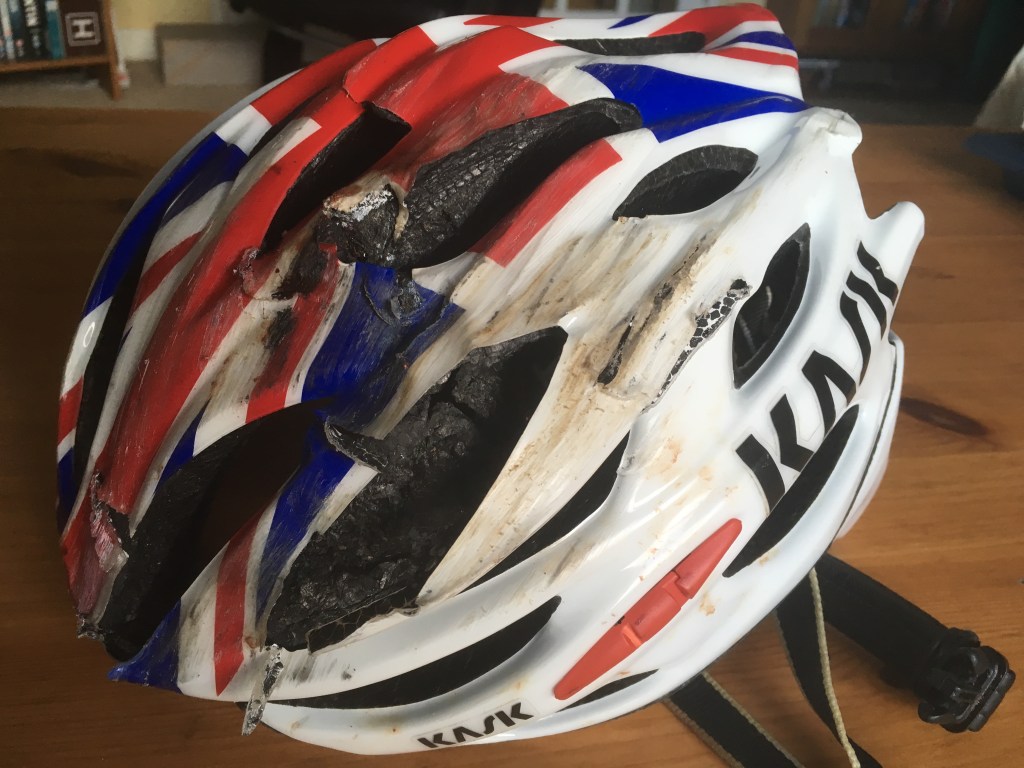
Therefore a shout out to Kask helmets – I picked the Mojito model I because I’d see it used in the professional cyclist peloton. It certainly did its job, but here it is after the accident – note the extensive cracks in the polystyrene.  This helmet will never be worn again, but I’m keeping it to show what happens in a crash!

Kask Mojito after the crash
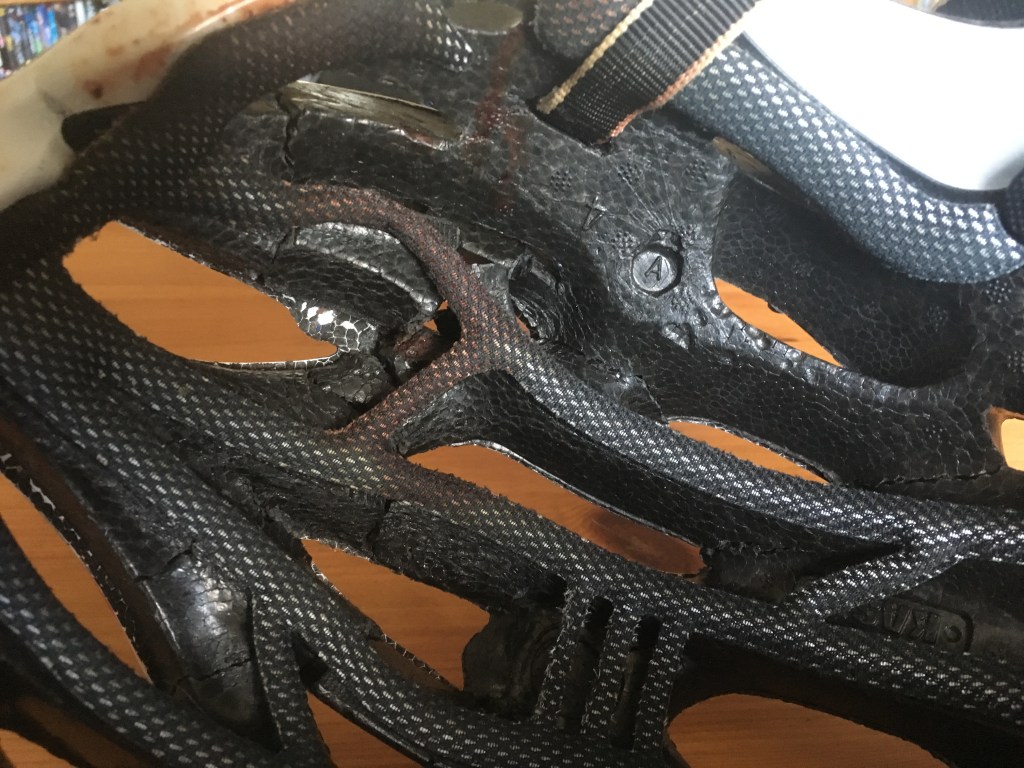
Inside the helmet – the blood is from a scratch on my forehead – npt my skull!

So, in conclusion I have a simple message:  

Always wear a good quality helmet that has never previously had an impact.  And make sure that the straps are tightly adjusted so that, in the unfortunate event of an accident, it stays on your head in the right place, before and during any impact.

And as an added point, after any incident that requires medical attention, please don’t remove the helmet – allow the medical professionals to do so!

The spiritual angle of helmet protection.

[As explained in my first blog post – I often get inspired when in a sporting context by parallel concepts that apply to my spiritual life as a Christian. If at this time you only want to ready the sporting bit of my blog (the section above) that’s fine, but it is my hope and prayer that you will find something here beyond the physical and practical story of my journey back from my serious bike accident.]

—————————————————

There’s a lot of religious meaning tied up with being ‘saved’.  But in this cycling incident we can imagine clearly what that consequence was of me wearing a helmet.

I chose to be out cycling that evening, wearing a helmet, I chose (to some extent) the speed and direction of my bike.  Yet when something happened outside of my control, by having the recommended level of protection, I was literally saved from much more serious injury.

As a Christian, I have committed myself to follow Christ and through faith I believe I have been fundamentally and completely accepted by God – I am saved from the consequences of my sin.  Nevertheless, to live the full life God intends for me I need help and I have to make right choices on a daily basis.

The apostle Paul wrote to the Church in Ephesus with a helpful metaphor:

Ephesians 6:13-17

13 Therefore put on the full armour of God, so that when the day of evil comes, you may be able to stand your ground, and after you have done everything, to stand. 14 Stand firm then, with the belt of truth buckled around your waist, with the breastplate of righteousness in place, 15 and with your feet fitted with the readiness that comes from the gospel of peace. 16 In addition to all this, take up the shield of faith, with which you can extinguish all the flaming arrows of the evil one. 17 Take the helmet of salvation and the sword of the Spirit, which is the word of God.

Holy Bible, New International Version®, NIV® Copyright ©1973, 1978, 1984, 2011 by Biblica,

So, alongside a range of metaphorical protective armour, we are encouraged to choose to wear a ‘helmet of salvation’.  That is to say – to have as a defence for our minds the confidence that, in Christ, that we are secure in Him – saved from the consequences of a life lived independent of Him.

Or put it another way.  The manufacturer’s instruction manual for how to live life recommends that we protect our heads /minds from being damaged by everything and anything that comes at us.

We’d be foolish to ride the bicycle of life without wearing that protection!

My brain was saved by my cycle helmet.  And my mind is being protected in the present by knowing who I am in Christ and what he has done for me.

So, if the learning from my bike crash is that you should always wear a recommended-quality cycling helmet, are you also wearing the manufacturer’s head protection plan for the whole of life?

Hello! (… or rather “Halo”)

Hello everyone, or rather “Halo”!

My name is Andy Biggs and I’m an age-group triathlete from the North East of England. I’ve recently gained a little weight on my shoulders as a result of a bike accident. On Thursday 22nd of August 2019, whilst descending a hill on my bike at around 30 mph / 48 kph, I suffered a rear tube blow-out. In subconsciously reacting to this, I managed to lock my front brake and catapult myself over my handlebars. Hitting the ground at speed it could have been much worse, but I’ve broken two vertebrae in my upper back and as a result I’ve been fitted with a neck/back brace, known as a Halo.

Hence the title of this blog – It starts with me wearing (or rather ‘sporting’) a Halo, and is intended in part to chronicle the process of getting back to a level of competitive fitness.  I‘ve taken inspiration from the story of Olympic Triathlete Tim Don whose own journey back to competition after a serious accident in 2017 was captured in a documentary you can watch here https://www.youtube.com/watch?v=UhjIchwAkAU

But I also hope for this to be a broader consideration of sport, spirituality/theology  and how they mix in the life of an average everyday person who is seeking to become the best they can be in mind, body and spirit.

Let’s see where we go!

Why am I doing this?

I have a high level of enthusiasm for swimming, biking and running, but at the root of my being I am a Christian, a follower of Jesus Christ. And I find that I get inspiration from God alongside my contemplation of sports science.

I’m not an Olympic or Professional athlete, but I’m an enthusiastic amateur with a competitive spirit to push my body to achieve its potential.  For the past 4 years I’ve managed to gain selection for my country, Great Britain, to compete at World and European Championships in several triathlon-related events. I’ve learned a few things along the way (mostly by mistakes….!)

But also for some time now I’ve felt God inspire me with spiritual parallels as I’ve gained experience in a sporting context. For as it says in the Bible in the book of 1 Timothy, Chapter 4, Verse 8:

“For physical training is of some value, but godliness has value for all things, holding promise for both the present life and the life to come.

Holy Bible, New International Version®, NIV® Copyright ©1973, 1978, 1984, 2011 by Biblica, Inc.®

I’ve been planning to write down many of these things, but I’ve not quite got around to starting despite putting it on my long-term goal list last year. However. my recent accident has enforced a period of inactivity – giving me the opportunity to pause and think about many things. Hence I’ve started to write this blog.

I hope you can find inspiration for your sporting and spiritual journey here.